
A practice for evaluating colonial relationships, feat. mince pie mindful eating
Plus, an end-of-year round up of essays I posted to Substack in 2025

Scroll down to skip to the review at the end of the post if you wish!
We need to expand our personal and cultural thresholds for discomfort, conflict, contradiction, and our emotional responses to structural and personal complicities in colonial violence. There’s all kinds of ways we can begin to do this even in very small ways in our individual lives.
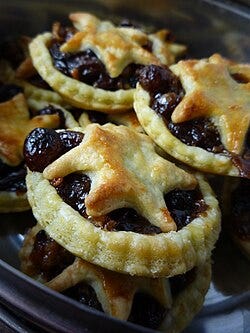
Here’s a short and simple mindful eating practice I did today while out hiking and eating a mince pie, followed by a short evaluation of some of the colonial relationships comprising my access to this food and the experience of eating it. First the eating practice, to allow myself to fully experience it, then the evaluation practice afterwards, to allow myself to focus on that task.
I visually examined all the materials the food is packaged in: mostly cardboard, different types of plastic, and aluminium foil.
I looked at the small pie itself. All the many gifts comprising this composite food came from billions of years of the evolution of life on our sacred earth.
I took small, deliberate bites and focused on the sensory experiences of the feel of the textures and the various tastes.
Mindful eating practices such as this are good for bringing one into momentary awareness of the sanctity and profoundness of earthly life, but in this time we inhabit — a time of incredible power imbalances, terrible violence, and crushingly immense coercive hierarchies — doing such a practice without any consideration of power dynamics is just indulging in a navel-gazing fantasy.
It would be lovely to just be able to enjoy food, but that’s not the world we live in. So at the very least, let’s enjoy the food we get, if and when we can get it, and consider the power we have and the power we don’t. It’s a simple practice in every day tolerance for sitting with uncomfortable and terrible things in a state of sobriety, which is a necessary step to actually being able to do something to alter the material circumstances shaping our lives. We’re really in disarray, and social movements keep repeating tactics and dynamics that don’t work or even cause more harm. So maybe we need to begin reconfiguring things at more fundamental levels?
Here’s my evaluation of some of the colonial relationships and power dynamics I can think of with regard to a seemingly simple small snack. I don’t have in-depth technical knowledge of any of these processes, so this is just my ‘napkin-math’ evaluation with the knowledge I do have.
Packaging materials
Cardboard requires industrial plantations of monoculture trees to be produced. It must undergo processing in industrial facilities for paper and wood pulp. This process is no doubt energy intensive, and the machineries are probably powered with oil among other things. The process of logging trees and transporting them also requires various oil-based technologies like trucks and ships, and it requires oil-based infrastructures that require consistent maintenance such as roads and ports. Much of the equipment used from logging to processing is made of various metals, requiring industrial mining and the production, upkeep, and replacement of all such tools and machines. At all points along the way, the coerced labour of people long rendered disposable parts of the global capitalist machinery must be abundantly available: to plant trees, to cut them, to process them, to transport them, to drill oil, to mine, to construct tools, to run stores selling all of these things. Having vast networks of people able and willing to do all this work requires ‘labour-gangs’1 that we commonly call ‘states’. These states enforce and reproduce artificial scarcity, ensuring that people have to sell their “labour” (ie. life force) in order to have any hope of surviving the brutality of the systems of artificial scarcity we commonly call ‘capitalism’ or ‘the market’ or ‘economics’. Most of these dynamics are true for all parts of my food — all the packaging and all the components of the food itself.
Obviously plastic is itself made from oil. Every item packaged in or made from plastic is tied to oil spills that have devastated the lives of countless other animals and plants, and to the pollution of waterways that give us cancer, and to the microplastics comprising the tissue of our brains that give us cancer, and to the chains of abuse at every level of its existence in our society: searching licences, discovery, fracking, refining, production. We hear all about how terrible plastic is all the time — and to be honest we tend to scapegoat it. Much easier to put your plastic in a recycling bin than to contend with the questionable ethics of our societies that pull ancient matter from the earth and produce plastic from it in the first place.
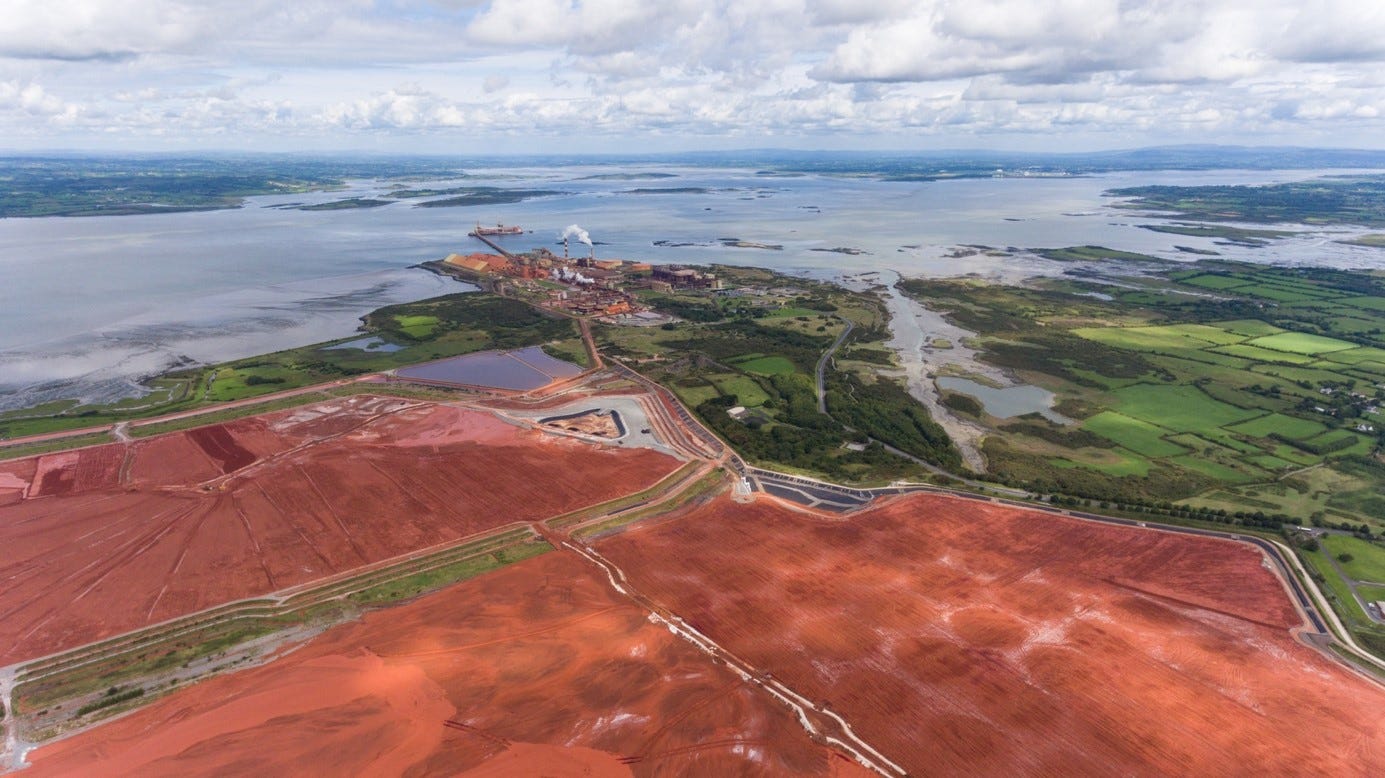
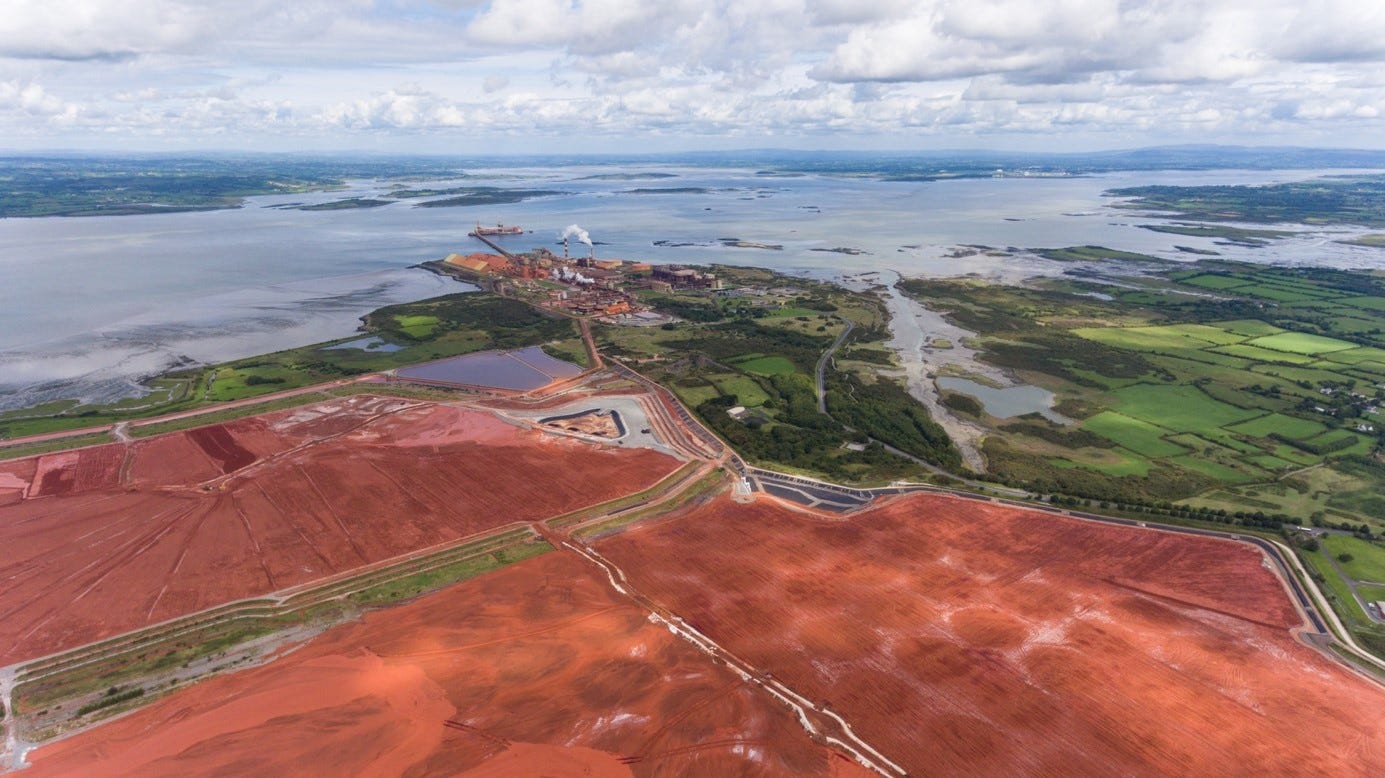
Aluminium is a truly terrible one. It is made from mining the mineral bauxite and refining it into alumina which can then be turned into aluminium. Just look at the aerial imagery of this bauxite refinery in Limerick, Ireland. It is an incredibly toxic process which can cause rare cancers to develop in both humans and other animals near the refineries. Who knows what the long term effects are on water and land where these orange mountains are piled up. Aluminium as a finished product also never breaks down, unlike plastic.
Mince pie ingredients
The ingredients of this mince pie are typical of much of the ultra-processed semi-edible matter that stands in for ‘food’ these days. Listing them all off would be boring, and I don’t even know what half of them are anyway. This fact alone tells a story of our hyper-alienation from every part of the process of making this food item. It just arrives into our hands fully formed. A person from almost any other time in the millions of years of human existence would likely struggle to understand what processed food even is, and how relationships could be configured in such a way on a global scale to facilitate their creation. This imaginary person would also probably struggle to understand anything that wasn’t “handmade” by someone we are in direct and intimate relationship with.
Let’s just consider a few of the ingredients that maybe show up in the actual flavour profile and visual ‘look’ of the pie. Brandy, sugar, sultanas, almonds, orange peel, eggs, milk, wheat flour. To make a low-hanging thematic metaphor, the history of any given ‘thing’ is always baked into its existence. The history of your body tells a story of billions of years of life coming into this form we call human. On smaller scales, the history of an alcoholic drink like brandy tells us about cultural practices of fermentation, agriculture, settled (non-nomadic) or semi-settled living, of a cultural preference for the effects of alcohol on one’s body. Maybe it tells you people in the society that produces this thing like to or need to numb themselves from something happening in their social environment. The existence of brandy in this pie obviously required those histories of agriculture, fermenting, brewing, and distilling. Sugar has a particularly grisly history within modernity, being one of the biggest and most lucrative crops cultivated by enslaved Black people during the Transatlantic Slave Trade. And, sugar is still cultivated by enslaved people today. Grapes, almonds, oranges: all plants that require a much warmer climate than the one I live in, and so necessitate all kinds of infrastructure to make them available to us in Ireland in the abundance that they are. Industrially produced plants also require vast amounts of toxic chemicals, between artificial fertilisers and pesticides. The production of eggs and milk depend upon enslaved animals. There’s no way to cushion this fact, which many people choose to try to do to make themselves feel better about consuming industrially produced animal products. I personally don’t see any way the consumption of industrially produced animal products can ever be ethical. The facts of most animal agriculture are readily accessible out there, but we generally don’t want to know about it. Wheat: people have probably been making little snacks like this from wheat flour since people started cultivating wheat in the Neolithic thousands of years ago. People operating machines probably do most of the planting, harvesting, and processing of wheat nowadays.
All of this is an invitation to consider and scrutinise parts of one’s own power in the world. Consider along the chain of events, historical and present, how a food item like a mince pie comes into being and makes it into your hands. Or, pick any other food item or random object that comes into your possession this Christmas. This can be done with anything and everything. Please don’t satisfy yourself with tat made from recycled materials or even something nice your friend handmade. There is no outside.
Ask who has power along the chain of events, in bigger ways and smaller ways, and ask what specific power they/we/you have. Given their/our/your power, how is their/our/your relationship to land, to other humans, to self, to animals, to plants etc. constituted and reproduced? What might interrupt those patterns of relating?
darius/dare carrasquillo wrote in a recent note on Substack: “until you yourself know how to balance your own desire for power, thinking rich people will do it “because it’s right” is just laughable. It’s likely that you yourself misuses the power you already have, in comparison to those who have less, and those who have less would gladly take yours from you because relative to them, you are doing it wrong.”
We all have far more power than most of us realise or are ready and willing to accept. Because with power comes responsibility, and we are culturally conditioned to be irresponsible and even chronically excuse our own and others’ irresponsibility and misuse of power.
2025 Review
Here’s my essays from this year, in order of popularity:


In the words of Fredy Perlman in Against His-Story, Against Leviathan